Learning by Doing: Why It Beats Passive Video Training
Learning by doing beats passive video every time. See the science, the $1.16T simulation boom, and how to build training that makes skills stick.

Companies are about to spend $1.16 trillion on training people by doing instead of watching. That is the 2030 projection for the virtual training and simulation market, up from $542.2 billion in 2025 and growing at 16.5% a year. The reason for the stampede is simple and a little uncomfortable: learning by doing works, and the passive video most training still relies on does not.
That gap between doing and watching is the most reliable finding in learning science, and it has a dollar figure attached now. In this post you will get the research on why active practice sticks, what the simulation boom actually signals for L&D teams, and how to make your own training active without buying a warehouse of VR headsets.
Why does learning by doing beat passive watching?
Learning by doing beats passive watching because memory is built by retrieving and using information, not by receiving it. When you watch a video, information flows in and feels familiar, which your brain mistakes for learning. When you do something, you have to pull the knowledge back out, and that act of retrieval is what wires it in.
The research term is retrieval practice, and the effect is large. In one middle-school study cited by Cult of Pedagogy, students scored a full grade level higher on material they had to actively recall through low-stakes quizzing versus material they only reviewed the normal way. Same students, same classroom, same content. The only variable was whether they did the work or watched it happen.
There is a counterintuitive piece here that trips up most training design. Effective learning should feel a little hard. Researchers call this desirable difficulty: the mild struggle of trying to remember or apply something is exactly what produces durable memory. As the team at RetrievalPractice.org puts it, with active recall "struggling becomes beneficial for learning." Passive video is engineered to remove that struggle, which is precisely why it feels pleasant and teaches so little.
Even the most advanced AI tutors are converging on this. When Google DeepMind tested its Guided Learning tutor in real classrooms, students gained roughly a year of math progress in eight weeks, and the system was deliberately built to make learners do the thinking. It asked guiding questions in 76% of its messages and handed over a straight answer only 2% of the time. Research director Irina Jurenka summed up the design principle bluntly: "in learning you really want to do the work yourself."
What the $1.16 trillion simulation boom signals for L&D
The simulation boom is the market voting with its wallet for learning by doing. Organizations are pouring money into flight simulators, medical and surgical trainers, VR safety drills, and immersive skill platforms because those formats force practice, and practice is what changes behavior on the job.
The numbers show how fast the shift is moving:
- The virtual training and simulation market hit $542.2 billion in 2025 and is projected to reach $1.16 trillion by 2030.
- It is compounding at roughly 16.5% a year, far outpacing the broader corporate training budget.
- The report names rising corporate training needs and safety-focused, high-stakes training as core drivers, alongside VR adoption and AI-powered learning modules.
Notice what is expensive about simulation and what is not. The headset, the motion rig, and the 3D environment are expensive. The thing that actually teaches, putting the learner in a situation where they must decide, act, and get feedback, is a design choice, not a hardware bill.
That distinction matters because most L&D teams do not need a surgical simulator. They need onboarding, compliance, product, and sales training that people remember. And the reason the simulation market is exploding is the same reason your compliance video gets clicked through at 2x speed and forgotten by Friday: watching is not doing.

You don't need a VR headset to make training active
You do not need VR to get the benefits of learning by doing, because the active ingredient is interaction, not immersion. A learner who has to answer, choose, explain, or apply is doing the cognitive work that builds memory, whether they are wearing a headset or watching a browser tab.
This is where most video training quietly fails and where it can be fixed cheaply. A standard training video is a one-way broadcast. The learner's brain is a passenger. Turn that same content into something that stops to ask a question, adapts to a wrong answer, and makes the learner respond, and you have converted passive minutes into active practice without changing a single fact in the script.
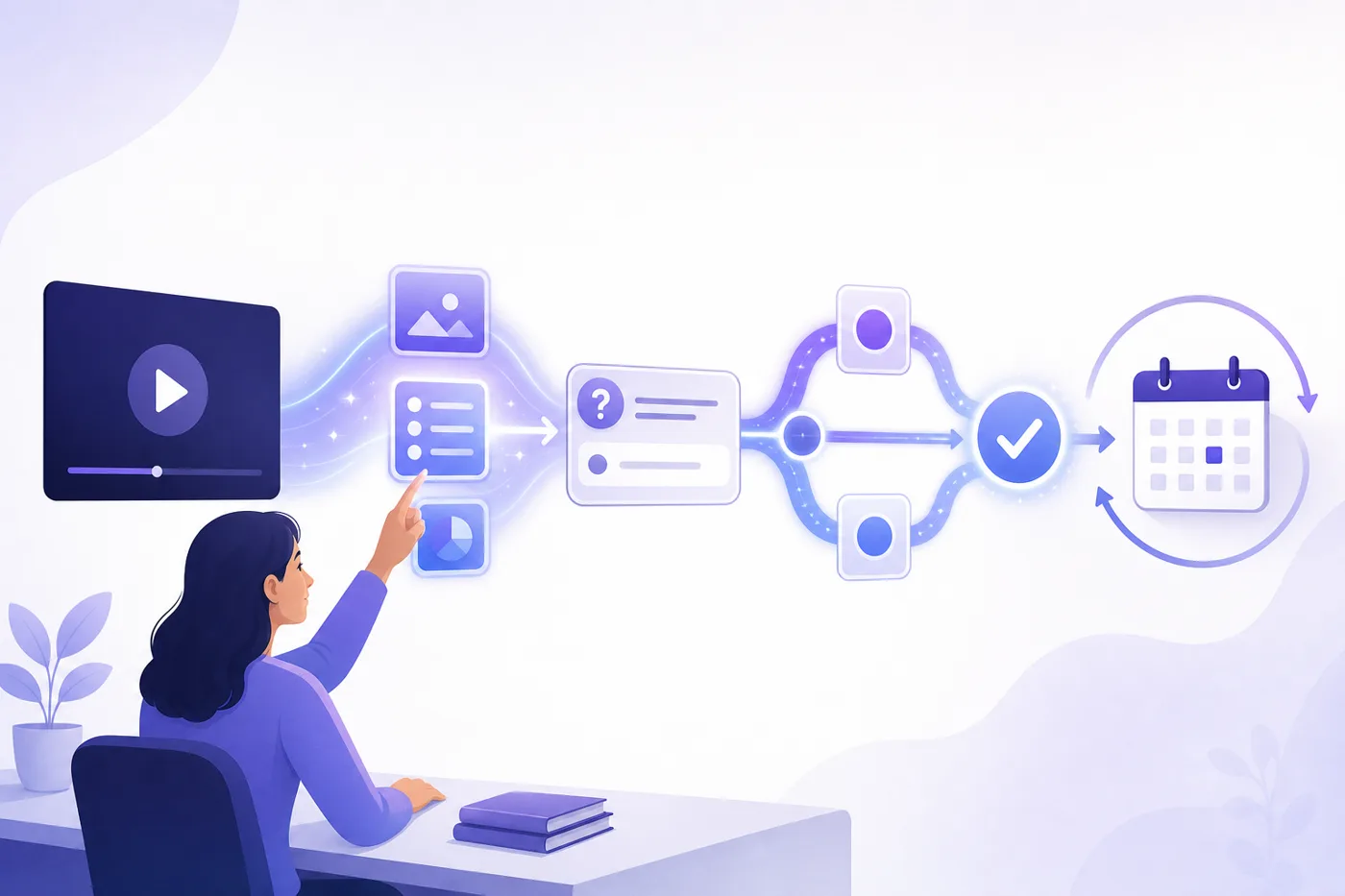
That is the core idea behind interactive training videos: keep the reach and low cost of video, but rebuild it so the learner has to participate. An AI tutor inside the video can pose a scenario, wait for the learner's answer, and respond to what they actually said, which recreates the retrieval-and-feedback loop that makes simulation and tutoring so effective, at video scale.
The lesson from both the learning science and the market is the same. The format that wins is not the flashiest. It is the one that makes the learner do the work.
How to turn passive training into learning by doing
You turn passive training active by designing for retrieval and response at every step instead of saving a quiz for the end. Here is a practical sequence L&D teams can run on existing content.
- Find the moments that matter. Identify the 3 to 5 decisions or skills a learner actually needs to perform on the job. Everything else is context, not the point.
- Replace telling with asking. For each key moment, convert the explanation into a question, a scenario, or a choice the learner must make before you reveal the answer. Aim to make them predict before they are told.
- Add feedback, not just scoring. When a learner responds, react to their specific answer. Explain why a wrong choice is wrong. Feedback is where the correction sticks.
- Build in desirable difficulty. Space the practice out and mix topics rather than blocking them. A little struggle and variety beats a smooth, easy run-through.
- Space the retrieval. Bring key ideas back a day and a week later. Memory is built by repeated retrieval over time, not one heavy session.
- Measure doing, not watching. Track whether learners can apply the skill, not whether the video played to completion. Completion rates measure attendance, not learning.
None of these steps requires new hardware. They require treating the learner as a participant instead of an audience.
Where learning by doing goes wrong
Learning by doing fails when organizations buy the technology and skip the design and support around it. A simulator, an AI tutor, or an interactive platform is only as good as the way it is implemented, and that part is easy to underfund.
Experts testifying on AI tutors recently made this point sharply. Professor Rose Luckin of University College London warned that "the best designed tool will not have the impact we want unless it is carefully implemented," and that building capacity in the people using it "is the most important part." Her colleague Professor Neil Selwyn noted how much invisible work goes into keeping these tools genuinely useful rather than merely impressive.
Translated to a company, the traps are predictable:
- Interaction theater. Adding a token quiz to a passive video and calling it active. If the questions do not force real retrieval or change what happens next, nothing improves.
- No feedback loop. Letting learners answer into a void. Practice without feedback drills in mistakes.
- Set and forget. Rolling out a tool without measuring whether behavior actually changes, which is how expensive platforms quietly become shelfware.
Learning by doing is a design discipline, not a purchase. The teams that win treat interaction as the product, not a feature they bolt on at the end.
FAQ
What is learning by doing?
Learning by doing is an approach where people build skills by actively practicing, deciding, and applying knowledge rather than passively reading or watching. It works because the effort of retrieving and using information is what forms durable memory, which is why hands-on practice consistently outperforms lectures and videos.
Is learning by doing better than watching training videos?
Yes, for anything you want people to remember and apply. Passive video feels efficient but produces weak retention because the learner does no cognitive work. The fix is not to abandon video but to make it interactive, so learners answer, choose, and get feedback instead of just watching.
How can a small L&D team make training more active without a big budget?
Start by converting your highest-stakes existing content into questions and scenarios that learners must respond to before seeing the answer, then add specific feedback and space the practice over days. This uses proven retrieval-practice principles and needs no VR hardware, just a shift from broadcasting information to prompting the learner to use it.
The market is spending over a trillion dollars to move people from watching to doing, but the principle underneath it costs nothing to adopt: knowledge sticks when learners have to use it. The most practical place to apply that is the training you already run, by turning passive video into interactive practice that asks, responds, and adapts. That is the difference between content people sit through and learning they carry onto the job.
Turn your training into an interactive experience
Nesoi transforms static content into interactive video experiences with AI tutors your team actually finishes.
Book a demo