Employee Onboarding Best Practices to Boost Retention
Employee onboarding best practices decide who stays. Only 12% of firms onboard well. Learn the interactive tactics that lift retention and productivity.

Only 12 percent of employees say their company does a good job of onboarding, and one in five get a bad experience or none at all. That is not an HR footnote. It is the moment a new hire quietly decides whether to commit or keep one eye on the job boards. In this guide you will get the employee onboarding best practices that actually move retention, the research on why most programs fail, and a checklist you can run this quarter.
The short version: passive onboarding, the welcome deck, the policy PDFs, the six hours of talking-head video, is where new hires disengage. The programs that keep people are interactive, adaptive, and built around doing rather than watching.
Why does employee onboarding fail so often?
Most employee onboarding fails because it dumps information instead of building competence. New hires sit through slide decks and recorded videos, nod along, and retain almost none of it by week two.
The numbers back this up. According to Gallup, only 29 percent of new hires feel fully prepared and supported to excel after their onboarding. That means roughly seven in ten walk out of orientation still unsure how to do the job you hired them for.
The cost shows up fast:
- The first week is decisive. A weak or absent onboarding experience is one of the strongest early predictors of regret and early exit.
- Ramp time is long. Gallup finds it takes about 12 months for a new employee to reach peak performance. Every week of that ramp you waste is money.
- Engagement compounds. Employees with an exceptional onboarding experience are 2.6 times more likely to be extremely satisfied at work, and 70 percent of them say they have the best possible job.
Passive content is the common thread in failed programs. You cannot fix a disengaged first week by adding more videos to watch. You fix it by making the new hire do something.
What do the best employee onboarding practices have in common?
The best employee onboarding practices share one trait: they make the new hire an active participant, not an audience member. Every strong program builds in doing, questioning, and feedback from day one.
Three principles separate onboarding that sticks from onboarding that wastes everyone's time.
- Active over passive. Replace watch-and-forget content with tasks, decisions, and practice. Retention lives in retrieval, not exposure.
- Adaptive over one-size-fits-all. A senior engineer and a first job graduate should not sit through the identical module. Good onboarding meets each person at their level.
- Manager-involved over hands-off. Gallup found employees are 3.4 times more likely to say their onboarding was successful when their manager actively participates. Onboarding is not something you outsource entirely to a portal.
The pattern is consistent across the research on learning itself. People remember what they practice and get feedback on, not what they are shown.

How interactive onboarding beats slide decks and PDFs
Interactive onboarding beats static content because active recall and adaptive difficulty produce far larger learning gains than passive viewing. This is one of the most robust findings in learning science, and it maps directly onto onboarding.
Consider the evidence from adaptive, AI-driven learning:
- In a five month study across 10 Taipei high schools, students who got personalized problem sequencing improved exam scores by 0.15 standard deviations, roughly six to nine months of extra learning, without any additional class time. As the Wharton researchers noted, both groups used the same AI chatbot. Only the adaptivity changed, and adaptivity is what moved the outcome.
- A six week interactive AI program in Nigeria produced learning gains of about 0.3 standard deviations, the equivalent of nearly two years of typical schooling, and outperformed 80 percent of education interventions studied in randomized trials, per the World Bank.
- Research synthesized by Brookings shows why: interactive tools create a psychologically safe space to ask questions and reveal confusion. But the same review warns that learners left to consume content without guidance show "very limited reflection." Structure and interaction are the active ingredients.
Translate that into onboarding and the lesson is blunt. A new hire who answers questions, makes decisions in a realistic scenario, and gets immediate feedback learns the role. A new hire who watches a two hour compliance video does not.
This is exactly why interactive training videos that ask questions and adapt in real time outperform the recorded webinar you have been reusing since 2023. The medium is not a cosmetic choice. It is the difference between a program that ramps people in weeks and one that loses them in the first month.
A practical employee onboarding checklist
The best employee onboarding process starts before day one and runs through the first 90 days with clear checkpoints. Here is a checklist you can adapt.
- Preboarding (before day one). Send the essentials early: equipment, accounts, a friendly welcome, and a short interactive intro to the team and mission. Remove day one friction so the first day is about people, not paperwork.
- Day one, connection first. Prioritize belonging over information. Introduce the manager, the buddy, and the team. Keep formal content light and interactive.
- Week one, learning by doing. Replace lecture modules with hands-on tasks and scenario based practice. Let new hires make low stakes decisions and get feedback immediately.
- Weeks two to four, role competence. Layer in role specific interactive training that adapts to what the person already knows. Assign a real, small piece of work with support.
- 30, 60, 90 day checkpoints. Set explicit goals for each milestone and review them with the manager. This is where the 3.4x manager effect pays off.
- Feedback both ways. Ask new hires what confused them and fix it for the next cohort. Onboarding is a product, and it should improve every month.
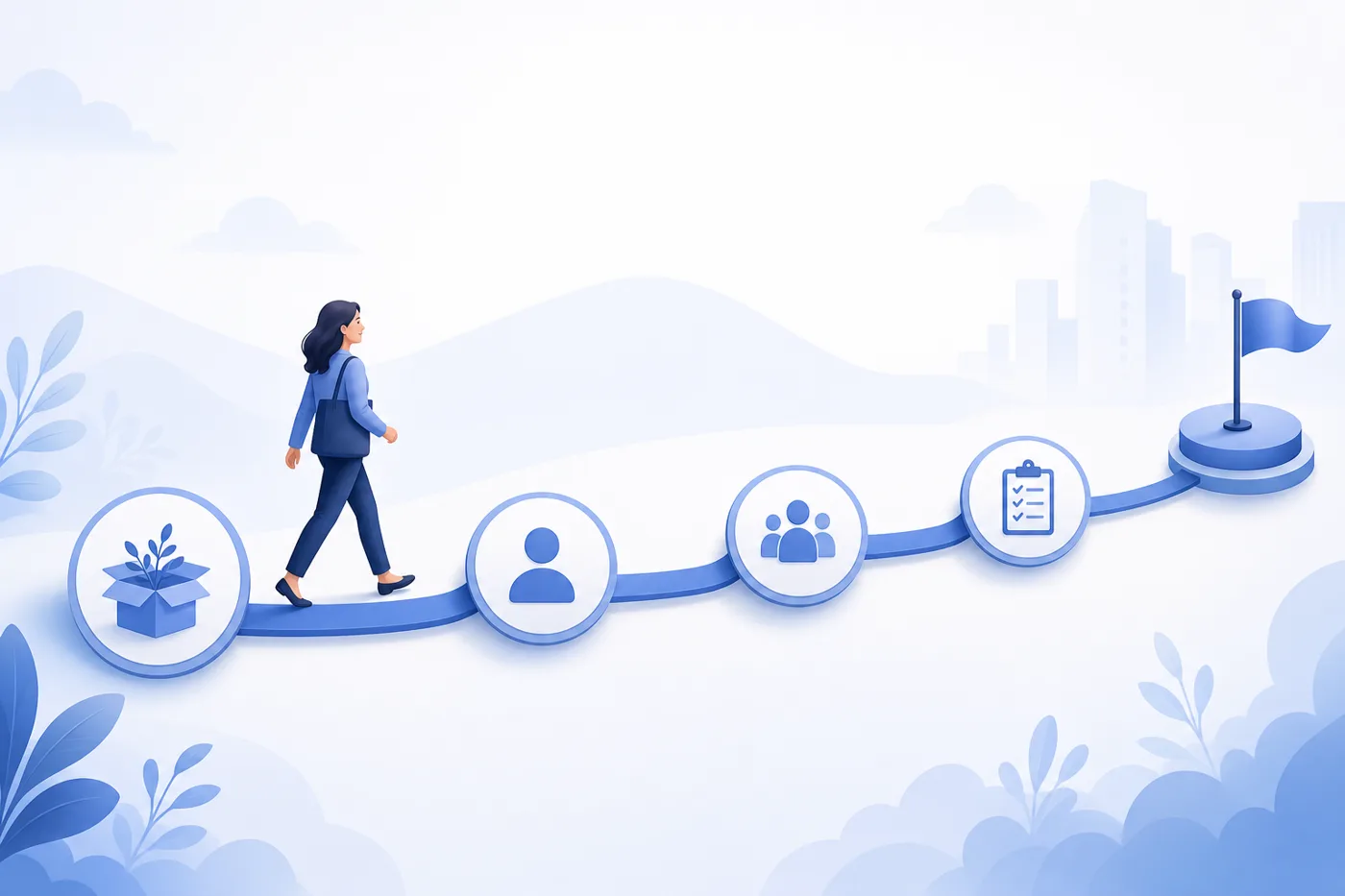
Notice how much of the checklist is about doing and checking in, and how little is about content delivery. That balance is the point.
How to measure onboarding that actually works
Measure onboarding by outcomes, not completion rates. A 100 percent module completion rate tells you people clicked next. It tells you nothing about whether they can do the job.
Track these instead:
- Time to productivity. How long until a new hire hits baseline performance? Interactive, practice based onboarding should shrink this against your 12 month benchmark.
- 90 day and one year retention. Early attrition is the clearest signal of an onboarding problem. Watch the first 90 days closely.
- New hire confidence and preparedness. Survey against Gallup's 29 percent baseline. If more than three in ten of your new hires feel genuinely ready, you are already ahead of most companies.
- Manager participation rate. Because it correlates so strongly with success, treat manager involvement as a metric, not a nicety.
If those numbers move, your onboarding is working. If only completion moves, you have a compliance exercise, not a learning experience.
FAQ
How long should employee onboarding last?
Effective onboarding runs far longer than the first week. Gallup finds new hires need roughly 12 months to reach peak performance, so the best programs extend structured support across the first year with 30, 60, and 90 day checkpoints rather than ending after orientation.
What is the biggest employee onboarding mistake?
The biggest mistake is treating onboarding as information delivery instead of skill building. Overloading new hires with passive videos and PDFs leaves only about 29 percent feeling prepared. Replacing that with interactive, hands-on practice is the single highest leverage fix.
Does interactive onboarding really improve retention?
Yes. Employees with a strong onboarding experience are 2.6 times more likely to be extremely satisfied at work, and satisfaction in the first weeks is a leading indicator of whether they stay. Interactive, adaptive formats drive the engagement that passive content cannot.
Onboarding is the first real test of whether your company can teach. Get it right and you compress ramp time, lift retention, and turn nervous new hires into confident contributors. The companies pulling ahead are the ones that stopped asking people to watch and started asking them to interact, adapt, and practice from day one.
Turn your training into an interactive experience
Nesoi transforms static content into interactive video experiences with AI tutors your team actually finishes.
Book a demo