How to Close the AI Skills Gap With Better Training
The AI skills gap risks $5.5T and most AI training isn't sticking. See why passive courses fail and how interactive training finally closes it.

Here is the paradox that should keep every L&D leader up at night: 82% of enterprises already offer AI training, yet 59% still report an AI skills gap. The money is being spent. The courses exist. The capability is not showing up. IDC now pegs the cost of that gap at $5.5 trillion in lost global productivity by 2026, and the single biggest reason is not too little training. It is the wrong kind of training. Below is what the data says is actually broken, and the interactive model that fixes it.
The short version: your people do not have an access problem. They have an application problem. And you cannot solve an application problem with a longer video.
Why is there still an AI skills gap when everyone offers training?
The AI skills gap persists because access to training does not translate into capability. Companies confused "we bought the courses" with "our people can do the work," and the two are not the same thing.
Look at where the numbers diverge. 82% of enterprises provide some form of AI training and 68% say employees have access to learning resources, according to DataCamp's 2026 analysis. But only 35% have a mature, organization-wide upskilling program. Access is nearly universal. Structure is rare.
The gap between those two facts is where the $5.5 trillion leaks out. IDC projects that over 90% of global enterprises will face critical skills shortages by 2026, and Workera's summary of the IDC report notes that only about one-third of leaders believe they have prepared employees effectively for AI roles.
Meanwhile the demand side keeps accelerating. PwC data cited in the same report shows AI-exposed roles are changing 66% faster than other jobs and command a 56% wage premium. The target keeps moving, and a course recorded last quarter is already describing a slightly different job.
Workers feel it. In one survey, only 26% of employees said they had received training on collaborating with AI (via Accenture, cited here). No wonder a Business Insider story this month landed so hard: your boss probably expects you to learn AI on your own time. When formal training does not build real capability, the burden quietly shifts to the individual, at night and on weekends.
What makes AI training fail to stick?
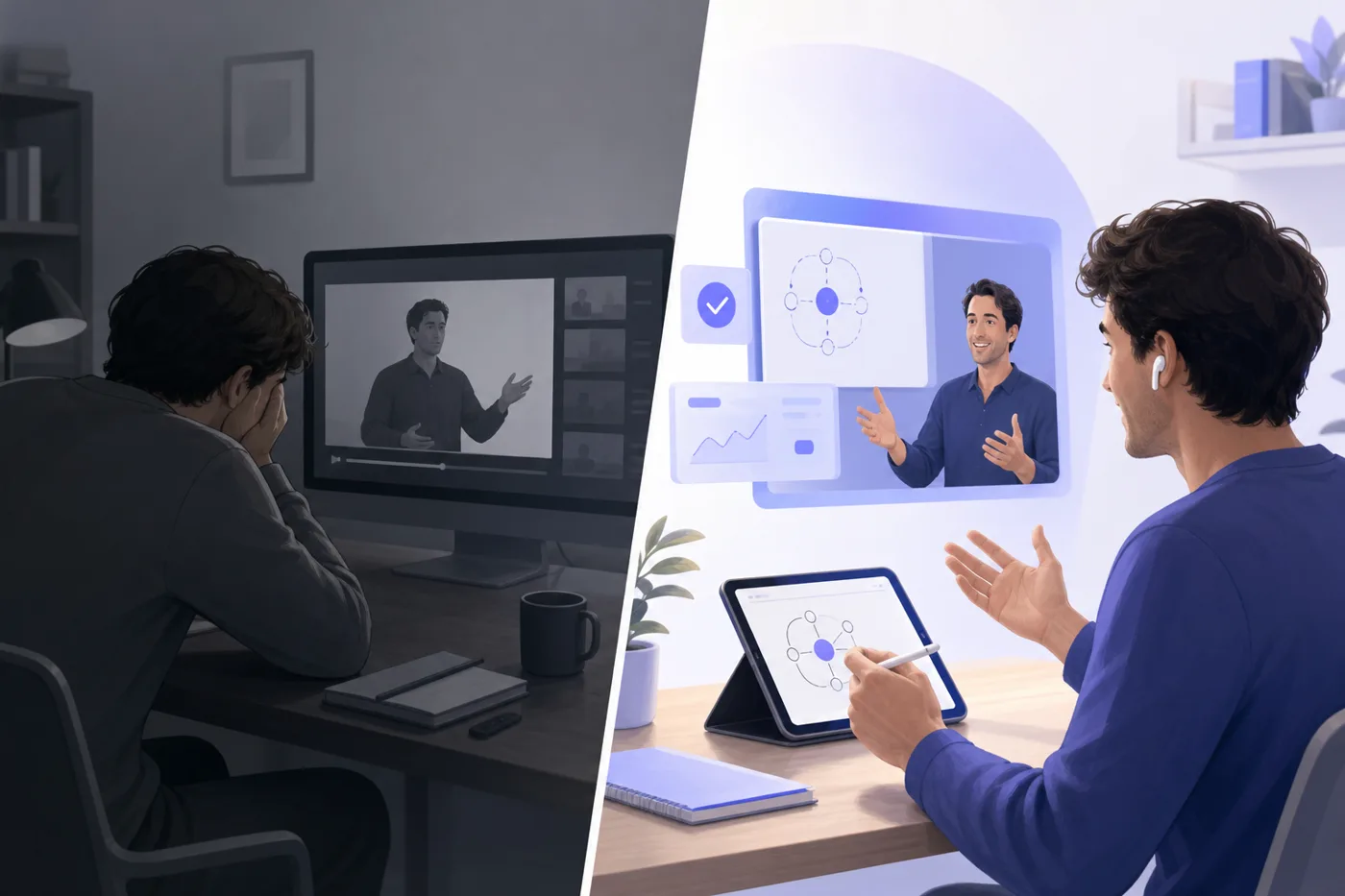
AI training fails to stick because it is passive, generic, and disconnected from real work. When learners watch instead of practice, the knowledge never gets encoded into behavior.
DataCamp's research puts specific numbers on the failure modes:
- 40% of AI training relies on video-based courses and blended online sessions, the most passive format available.
- 23% of learners say video courses make it difficult to apply skills to their actual jobs.
- 24% cite a lack of hands-on projects or labs as a core problem.
- 23% say learning paths are not tailored to their specific role, and 21% do not even know where to start.
Read those together and a clear picture emerges. People are handed a generic video library, told to figure out what is relevant, and then evaluated on whether they can apply skills they were never asked to practice. That is not a motivation failure. It is a design failure.
The classroom world is learning the same lesson in public. A recent Tes report found that AI tutors can "make more work" for teachers when bolted on badly, and a widely shared study concluded that simply giving students access to a free AI tutor did not mean they used it. Human structure and active prompting changed the outcome. Access alone, again, was not enough.
The pattern is identical in the enterprise: passive delivery plus optional engagement equals a skills gap, no matter how big the content library is.
How interactive training closes the AI skills gap
Interactive training closes the AI skills gap by replacing passive watching with active practice, real-time feedback, and content that adapts to each learner's role and pace. Capability is built through doing, not viewing.
The ROI data makes the case bluntly. Organizations with mature, structured upskilling programs report 42% significant positive AI ROI, versus just 21% for everyone else, and only 11% see no returns compared to 17% without a real program. As DataCamp puts it, "AI tools alone do not create impact, but workforce capability does."
So what does capability-building actually require? Four things the passive video model cannot deliver:
- Active recall instead of passive playback. Learners have to answer, decide, and produce, not just press play. Retrieval is what moves knowledge into long-term memory.
- Real-time feedback. A wrong answer gets corrected in the moment, while the learner still cares, not on a quiz three weeks later.
- Role relevance. The finance team and the support team should not sit through the same generic module. Adaptivity fixes the "not tailored to my role" complaint that 23% of learners raised.
- Practice that mirrors the real task. The 24% asking for hands-on labs are asking for the one thing that transfers: rehearsal of the actual work.
This is exactly the shift from passive to active that Nesoi is built around. Instead of recording another lecture, you can turn the same material into interactive training videos where an AI tutor asks questions, responds to answers in real time, and adapts the path to each learner. The content stops being a broadcast and becomes a conversation, which is where knowledge actually sticks.

How to build AI training that actually changes behavior
Build AI training that changes behavior by designing for application from the first minute, not the final quiz. The goal is not course completion. It is demonstrated capability on the job.
A practical sequence that maps to the research:
- Start from the task, not the topic. List the specific things each role needs to do with AI this quarter. Build backward from those tasks so training is role-relevant by default.
- Convert lectures into interactions. Every place you would have said "watch this," ask "what would you do here?" instead. Turn explanation into a prompt and a response.
- Add a tutor that responds. Real-time feedback is the highest-leverage change you can make. An AI tutor that reacts to each answer gives every learner the human-style guidance that classroom studies show drives adoption.
- Adapt the path. Let confident learners move fast and give struggling ones more practice. One-size-fits-all is why 21% did not know where to start.
- Measure capability, not clicks. Track whether people can perform the task afterward, not just whether the video finished. That is the metric tied to the 42% ROI, not seat time.
None of this requires a bigger content budget. It requires a different format. The companies pulling ahead are not the ones with the most courses. They are the ones whose training produces people who can actually do the work.
The AI skills gap is not going to be closed by watching more. It will be closed by doing more, with feedback, in context. That is the whole difference between training that decorates a compliance report and training that shows up in performance. Interactive learning is how you cross that line, and the organizations that make the switch are the ones turning their AI investment into the capability everyone else is still waiting for.
FAQ
What is the AI skills gap in simple terms?
The AI skills gap is the difference between the AI capabilities a company needs and what its workforce can actually do. It persists even when training exists, because access to courses is not the same as the ability to apply skills at work. IDC estimates the gap could cost $5.5 trillion in lost productivity by 2026.
Why isn't our AI training working even though everyone completed it?
Course completion measures attendance, not capability. If your training is passive video with no practice or feedback, learners can finish every module and still be unable to do the task, because they never actually rehearsed it. Switching to interactive, role-specific practice is what turns completion into competence.
How is interactive training different from an online AI course?
An online course is usually a one-way broadcast: you watch and maybe take a quiz. Interactive training asks you to respond throughout, gives real-time feedback, and adapts to your role and pace. That active loop is why structured, interactive programs report roughly double the AI ROI of passive approaches.
Turn your training into an interactive experience
Nesoi transforms static content into interactive video experiences with AI tutors your team actually finishes.
Book a demo