AI Training at Scale: What Big Employers Get Right
AI training at scale is the new L&D test. See how Walmart, FedEx and others train hundreds of thousands, and how to make it actually stick.
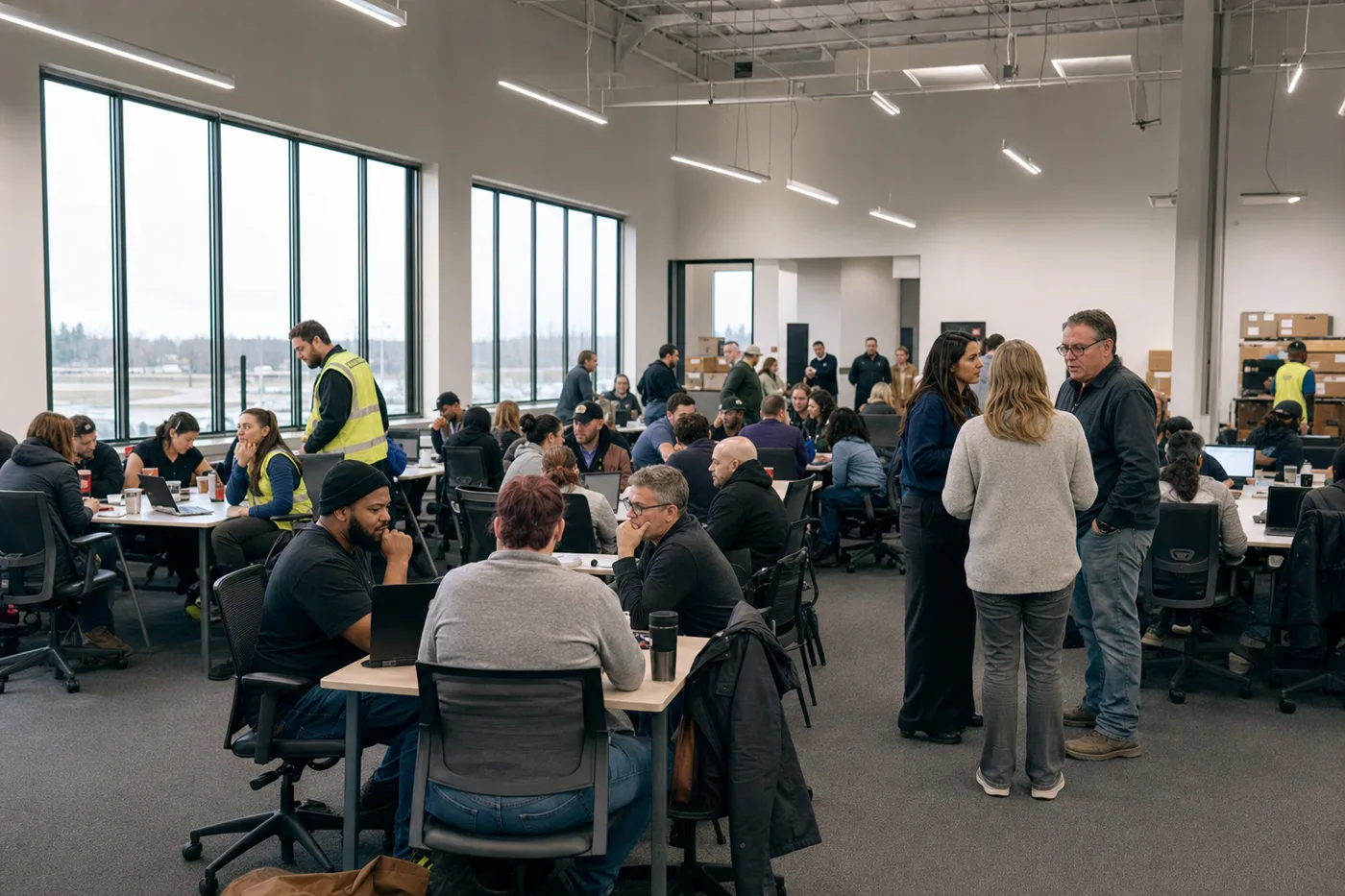
Walmart is about to give free AI training to 1.6 million employees. FedEx is running a version of the same play for more than 400,000. The stat that makes those numbers interesting is 42 years old: in 1984, the researcher Benjamin Bloom showed that one-to-one tutoring lifts the average student above 98 percent of their classroom peers, then admitted almost no organization could ever afford to deliver it. AI training at scale is the bet that this tradeoff, personal or affordable but never both, is finally breakable. Below is what the biggest programs of 2026 are getting right, why the old tradeoff held for 40 years, and where most companies still get it wrong.
Why are Walmart and FedEx training whole workforces on AI?
They are training everyone because the skills their people need are expiring faster than they can hire replacements, and buying AI tools without building AI skills just creates expensive shelfware.
The clock is the problem. The World Economic Forum's Future of Jobs Report 2025 estimates that 39 percent of workers' core skills will be transformed or outdated by 2030, and that 59 of every 100 workers will need training in that window, according to reporting on the report. Skill gaps are now the single biggest barrier to business transformation, cited by 63 percent of employers.
Money is not the constraint. Companies already spend more than $400 billion a year on corporate training, yet 74 percent say they are not keeping up with their own demand for new skills, Josh Bersin's 2026 research found. LinkedIn data in the same analysis pegs the churn bluntly: roughly 70 percent of the skills used in any job go out of date every year.
So the giants are choosing to train rather than replace, at a scale that used to be unthinkable:
- Walmart is offering free AI certification to its 1.6 million U.S. and Canadian associates, out of 2.1 million globally, through Walmart Academy and an eight-hour course built with Google, Fortune reported. Every U.S. staffer can also get certified in OpenAI tools. "Technology will power our future," said chief people officer Donna Morris. "But our associates will lead it."
- FedEx has rolled out AI training to more than 400,000 of its roughly 500,000 workers, built with Accenture and launched in December 2025, per Yahoo Finance. The company frames it as making people "promotion-ready."
The honest footnote: FedEx has also closed facilities and cut jobs, so training is not a promise that no one gets displaced. But the design choices inside these programs are the part worth copying, and they start with a very old problem.
What Bloom's 2 sigma problem reveals about training at scale
The hardest part of training at scale was never the content. It was that the best way to teach, one adult sitting with one learner, has never been affordable for more than a handful of people at a time.
Bloom put a number on how good that method is. In his 1984 study, students who got one-to-one tutoring paired with mastery learning performed two standard deviations better than students in a normal classroom, which put the average tutored student above 98 percent of the conventionally taught group, as summarized in the research on his "2 sigma problem". Roughly 90 percent of tutored students reached a level only the top 20 percent of the classroom ever hit.
Then came the catch. Bloom called tutoring "too costly for most societies to bear on a large scale," and framed the real challenge as finding "methods of group instruction as effective as one-to-one tutoring." For 40 years, nobody solved it. You could have reach or you could have personalization. Every organization that tried to train a lot of people at once had to give one of them up.

Why classroom and video training both fail at scale
Every attempt to scale training so far has quietly sacrificed the personalization that makes it work: the classroom keeps the human but caps the reach, and the video keeps the reach but drops the human.
The classroom is the tutor's poor cousin. An instructor can read the room, but the room has 30 seats and the instructor has a calendar. Try to reach 400,000 people that way and you are hiring an army of trainers or waiting years for the schedule to clear.
Recorded video fixed the reach and broke everything else. A single video can play for a million people, but it cannot tell whether any of them understood a word. It never asks a question, never adapts, never notices the learner who quietly checked out at minute three. That is why Bersin's research calls the 30-year-old model of e-learning and video courses "no longer sufficiently dynamic, personalized, or comprehensive," describing it as a "publishing model" that top teams have already moved past.
Scale makes the flaw worse, not better. FedEx explicitly built what its chief data and information officer, Vishal Talwar, called "a living curriculum that will continue to refresh itself every month, every quarter." A static video library cannot do that. In a field where the tools change monthly, a recorded course can be stale before the whole workforce has finished watching it.
How AI training at scale finally gets personal
AI training at scale works by giving every learner a responsive tutor at the marginal cost of software, which is the first delivery model to offer Bloom's personalization and mass reach at the same time.
The economics have flipped. Where a human tutor costs the same for each new learner, an AI tutor costs almost nothing to add one more. Bersin's research reports that early AI-native learning teams are seeing a 40 to 50 percent reduction in internal L&D spend while building new courses in days instead of months. The expensive part of training is no longer delivery. It is design.
People are already voting for this format with their attention. Bersin notes that about 60 percent of the roughly 900 million people using ChatGPT each week are learning something, which is more than any corporate course catalog has ever pulled off. The reason is not the content. It is that the thing talks back.
That is the mechanism Bloom was pointing at. A tutor works because it adapts: it asks, it waits, it corrects the specific thing you got wrong, and it moves at your pace. Software can now do that for everyone at once. Interactive training videos that stop to ask a question, respond to the answer, and adjust the next few minutes turn a passive viewer into an active participant, which is the whole ballgame at scale.

What the biggest AI training programs get right
The programs reaching hundreds of thousands of people share a pattern, and it looks nothing like a mandatory video playlist. Five choices show up again and again:
- Role-specific, not generic. FedEx built personalized, role-based paths rather than one course for everyone, because a dispatcher and a finance analyst need different things. Generic training is the fastest way to lose a busy adult's attention.
- Living, not published once. The curriculum refreshes on a monthly and quarterly cycle. When tools change constantly, the content has to be regenerated, not re-recorded, which is exactly what AI-native systems do cheaply.
- On the clock, not on your own time. These programs run during work hours through platforms like Walmart Academy and Accenture's LearnVantage. Putting learning on company time signals that the skill matters and removes the excuse that beats every voluntary program.
- Framed as advancement, not compliance. Walmart ties AI skills to store-leadership roles where top regional managers can earn up to $620,000, and FedEx sells its program as getting people "promotion-ready." People engage with a path to a better job, not with a checkbox.
- Measured by capability, not completions. A completion certificate proves someone clicked "next." The programs worth copying watch whether people actually use the tools well, which is only possible when the training is interactive enough to generate that data in the first place.
None of these depend on a bigger budget than the AI tools themselves. They depend on spending a slice of that budget on the humans who have to use them, and on a delivery format that can personalize without a personal instructor for each of the 400,000.
FAQ
What does AI training at scale actually mean?
It means delivering personalized, adaptive training to a very large workforce, often hundreds of thousands of people, without hiring a proportional army of instructors. The goal is to give each learner something closer to one-to-one tutoring while still reaching everyone, which older classroom and video models could never do at once.
Can you really personalize training for thousands of employees at the same time?
Yes, and that is the whole shift. This is precisely Bloom's "2 sigma problem," the fact that one-to-one tutoring works far better than group instruction but was always too expensive to scale. An AI tutor that adapts to each learner costs almost nothing to extend to one more person, so personalization and reach stop competing.
How much does large-scale AI training cost?
Less than most leaders expect, because the cost has moved from delivery to design. Josh Bersin's research reports AI-native learning teams cutting internal L&D spend by 40 to 50 percent while producing courses in days instead of months. The tools are often the biggest line item, so the smart move is funding the training that makes those tools pay off.
The companies pulling ahead are not the ones with the biggest training budgets. They are the ones that finally made personalized practice scale, replacing the passive video that was only ever a compromise forced by cost. Bloom's 40-year-old problem has a working answer now, and the organizations acting on it are training millions of people without flattening them into an audience.
Turn your training into an interactive experience
Nesoi transforms static content into interactive video experiences with AI tutors your team actually finishes.
Book a demo