AI Soft Skills Training: Why Practice Beats Passive Video
AI soft skills training works when people practice, not just watch. See how AI roleplay makes hard conversations measurable and where to start.

Soft skills now shape careers more than technical ones, yet most companies still "train" them with a video and a quiz. LinkedIn found that employees who pair strong soft skills with hard skills get promoted 8% faster, and the ones who refresh their skills every quarter move up 11% faster than people who update once a year or less. This is a guide to why AI soft skills training built on practice, not passive video, finally closes the gap, what Synthesia's new roleplay launch signals for the market, and how to run your first program.
Here is the uncomfortable part. You cannot learn to handle a furious customer, deliver hard feedback, or close a hesitant buyer by watching someone else do it. Those are behaviors, and behaviors get built by doing, failing, and adjusting. For the last decade, most training programs skipped the doing.
Why soft skills are suddenly the most valuable skills
Soft skills are now the strongest predictor of who gets ahead at work. The data has gotten hard to argue with, even for people who used to dismiss "soft" as fluffy.
LinkedIn's analysis of promotion patterns is blunt about it. Workers with organizational skills, teamwork, problem-solving, and communication were promoted 11% faster, and those with leadership skills moved up 10% faster. As LinkedIn researchers put it, "Even if you can't easily measure the skill itself, they still make a measurable difference." You can read the full LinkedIn promotion findings on HR Dive.
Employers feel it on the hiring side too. According to TalentLMS, 93% of employers cite soft skills as a deciding factor in hiring, and 85% of job success comes from well-developed soft skills. The catch: 60% of hiring managers say soft skills are hard to assess in the first place. You can see the broader soft skills data TalentLMS pulled together.
Put those together and you get a strange gap. The skills that matter most for promotion and hiring are also the ones companies are worst at teaching and measuring.
Why passive training video fails at soft skills
Passive training video fails at soft skills because watching a conversation is nothing like having one. Soft skills are performances under pressure, and you cannot rehearse a performance by sitting still.
Think about how a typical soft skills course runs. A learner watches a polished video of an ideal manager giving feedback, nods along, answers a multiple-choice question, and gets a completion checkmark. Then a real employee walks into their office upset, and none of that transfers.
The problem is not the video quality. It is the missing reps.
- No practice. Knowing what active listening looks like is not the same as doing it when someone is talking over you.
- No pressure. Real conversations have stakes, interruptions, and emotion. A calm demo video removes all three.
- No feedback. Watching gives you zero signal about whether you would actually handle the moment well.
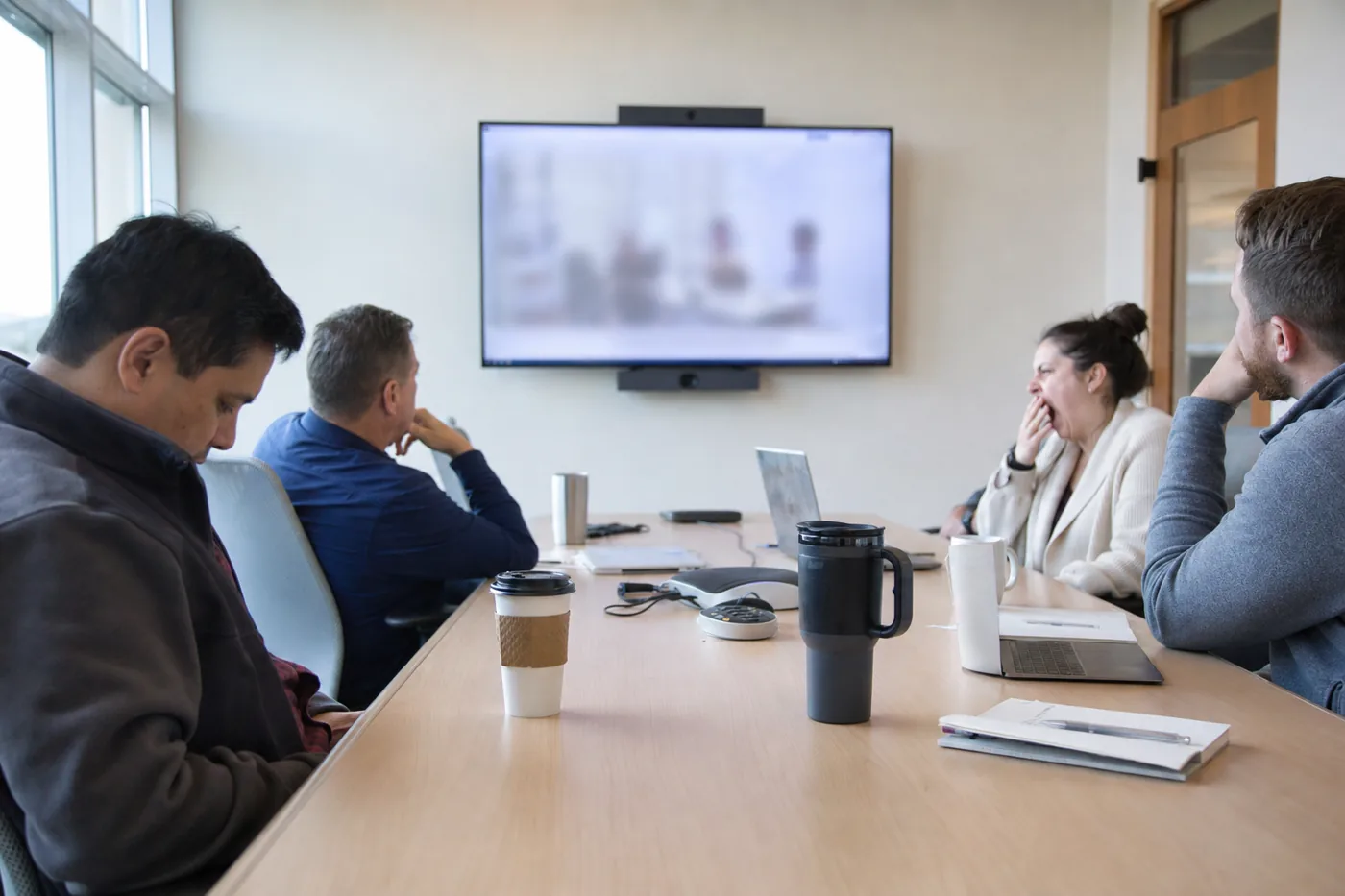
This is why so much soft skills training feels like theater. People sit through it, the completion rate looks great in the dashboard, and behavior on the floor does not change. Even Synthesia CEO Victor Riparbelli, who built a company on training video, admits the limit: "Video performs way better than text or sending out a document. But for most things, we learn the best by actually practicing something rather than just reading it."
What AI soft skills training actually is
AI soft skills training replaces "watch and recall" with "practice and improve." Instead of consuming content, the learner has a live conversation with an AI that plays a role, reacts in real time, and then tells them how they did.
The clearest example is AI roleplay. A learner opens an assigned scenario, say a frustrated customer or a discovery call, and simply starts talking. The AI avatar listens, responds naturally, pushes back, and stays in character. When the conversation ends, the learner gets scored against a rubric and coached on what to fix.
This is the same shift Nesoi builds toward with interactive training videos: turning content someone passively watches into an experience that talks back, asks questions, and adapts to the learner. The medium stops being a lecture and starts being a rehearsal.
Research has backed this approach for years. In a controlled study called Rehearsal, presented at the CHI 2024 research conference, people who practiced a tense conversation with an AI partner cut their escalating, combative tactics by roughly 67% in a later real conflict, and about doubled their use of cooperative strategies, compared with a control group that only read a lecture on the same theory. Practice beat passive instruction, and it was not close. What changed recently is cost and realism: AI can now run those simulations at scale, on demand, without scheduling a human roleplay partner or the embarrassment of practicing in front of peers.
How AI roleplay training works
AI roleplay training works as a practice loop: rehearse a scenario, get scored, get coached, then try again. Each pass sharpens the behavior, which is exactly how real skills get built.
Here is the loop most modern tools follow:
- Assign a scenario. A cold call, a performance review, an at-risk customer, a difficult teammate. The company sets the context and the standards.
- Practice live. The learner talks to an interactive AI avatar that responds and pushes back in real time, no script required.
- Score against a rubric. The AI grades multiple dimensions, the specific competencies that matter for the role, not just a pass or fail.
- Coach the gaps. The learner gets targeted feedback on what went well and what to improve.
- Repeat. Scores get tracked across attempts, so improvement is visible over time.

The important word in that loop is measurable. Managers get an analytics view showing who is improving, where the gaps are, and how a whole team is trending. Soft skills, the thing everyone said was impossible to quantify, suddenly produce data.
What Synthesia's roleplay launch signals for L&D
Synthesia's Roleplay Sessions launch signals that the AI training market is moving from making content to measuring performance. On July 22, 2026, the company known for AI avatar videos released a product where employees practice high-stakes conversations with an avatar that talks back, pushes back, and scores them against a rubric.
The strategic message is louder than the feature list. As TechCrunch reported, the move positions Synthesia "less as an AI avatar company and more as a performance-management platform." Early customers reportedly include one of the top three European companies by market cap and a top-five Fortune 100 firm.
Riparbelli framed the upside in numbers: "If you have your entire sales team practice with an AI role player, you can get very granular data on how your sales force is doing overall." The Roleplay Sessions product page makes the same pitch, promising to turn "forgettable training" into "practice that makes people ready."
For L&D leaders, the signal is clear. The bar for training is shifting from "did they complete it" to "did they get better," and the tools to prove it now exist. Completion rates were always a vanity metric. Skill uplift is the real one.
How to run your first AI soft skills training program
Start with one high-stakes conversation your team gets wrong often, then build a tight practice loop around it. You do not need to reinvent your whole curriculum to see whether practice beats passive video.
- Pick one scenario with real stakes. Choose the conversation where mistakes cost the most: objection handling, a tough performance review, a churning customer.
- Define what "good" looks like. Write a short rubric of three to five behaviors you can score, like acknowledging emotion, asking a clarifying question, or proposing a next step.
- Let people practice privately first. The biggest advantage of AI roleplay is that learners can fail in private and retry, without an audience.
- Coach on specifics, not vibes. Feedback should point to the exact moment and behavior, not "be more confident."
- Track improvement across attempts. Look at whether scores rise from the first try to the third, not just whether the module was completed.
- Tie it to a real outcome. After a few weeks, compare practiced behaviors against something that matters: win rates, CSAT, ramp time, retention.
Run that loop with a small group, measure the lift, and let the data decide whether you expand. This is how you move from training that feels productive to training that provably works.
FAQ
Can AI really teach soft skills, or just hard skills?
AI is arguably better suited to soft skills than hard ones, because soft skills are practiced in conversation and AI can hold an unlimited number of realistic conversations. The learner rehearses a real scenario, the AI reacts and pushes back, and both get feedback. Research on simulation roleplay shows measurable gains in communication, empathy, and conflict resolution when people practice this way.
How is AI roleplay training different from watching a training video?
A training video shows you what good looks like, while AI roleplay makes you do it and tells you how you did. Video is passive recall, and roleplay is active practice with feedback and scoring. That difference maps directly to how skills actually form: through reps under pressure, not through watching.
Is AI soft skills training measurable?
Yes, and that is a big part of why it is spreading. Modern AI roleplay tools score each attempt against a rubric across specific competencies, then track those scores over time. Managers can see who is improving, where the gaps are, and how a whole team is trending, turning a category once dismissed as unmeasurable into real data.
The lesson underneath all of this is simple. People learn by doing, and for years training technology forced them to watch instead. AI finally lets practice scale, which is why the smartest L&D teams are trading passive video for interactive experiences that let every learner rehearse, get feedback, and actually get better.
Turn your training into an interactive experience
Nesoi transforms static content into interactive video experiences with AI tutors your team actually finishes.
Book a demo